
The Gujarat Industrial Policy 2026 (GIP 2026), seeks to position Gujarat as India’s most competitive manufacturing and services hub. One of the distinguishing features of the Gujarat Industrial Policy 2026 is its carefully designed incentive framework. The policy offers incentives according to the size of investment, employment potential, technology intensity, sectoral priority and regional location. This marks a significant shift from traditional industrial policies that largely relied on uniform capital subsidies.
The policy encourages industries to choose a combination of capital subsidy, interest subsidy and power tariff support based on their business model, thereby allowing greater flexibility while maintaining fiscal prudence. Higher incentives are available for investments in Category A talukas and identified thrust sectors, ensuring that industrial growth also contributes to balanced regional development. Among others the incentive framework has strong focus on the following four aspects:
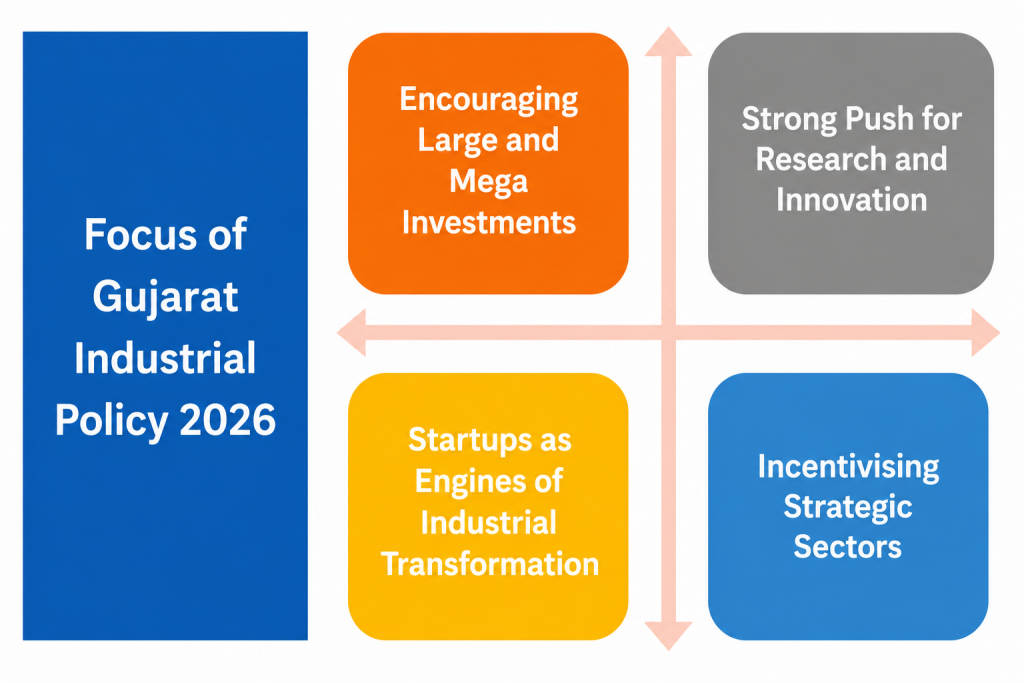
Incentivising Strategic Sectors
The policy provides enhanced incentives to selected thrust sectors such as sports goods and equipment, toys, footwear, robotics and drones, while retaining flexibility to notify additional strategic sectors in future. These industries can receive significantly higher ceilings for capital subsidy, interest subsidy and power tariff assistance than general manufacturing units. Such targeted incentives are intended to strengthen domestic value chains, reduce import dependence and position Gujarat as a leader in future-oriented manufacturing.
Encouraging Large and Mega Investments
To attract transformational projects, the policy introduces differentiated support for Large, Mega and Ultra-Mega industrial units. Policy allows Large, Mega and Ultra-Mega Projects higher incentive package comprising capital subsidy, interest subsidy and concessional power tariffs. It has provisions for even higher incentives if such units are located in priority regions marked as Taluka ‘A’. Ultra-Mega projects also receive additional benefits such as reimbursement of stamp duty and registration fees, 100% electricity duty exemption and extended EPF reimbursement, making Gujarat one of the country’s most attractive destinations for large manufacturing investments.
Strong Push for Research and Innovation
The Policy proposes to establish a Gujarat Research and Innovation Park equipped with common laboratories, testing facilities, incubation centres and intellectual property support services. This is perhaps the most forward-looking element of the 2026 policy.
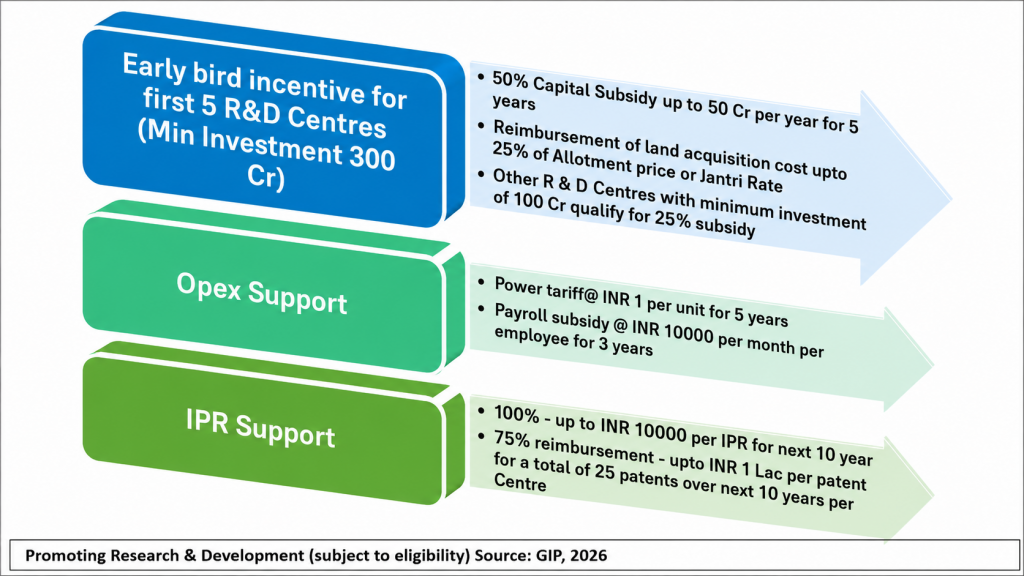
The incentive package for R&D centres is particularly attractive. The first five large R&D centres investing at least ₹300 crore are eligible for 50% capital subsidy on buildings, machinery and equipment (subject to prescribed limits), reimbursement of land cost, concessional power tariff, payroll assistance, intellectual property reimbursement and patent support. Other R&D centres investing at least ₹100 crore also receive substantial capital assistance and operational support.
Startups as Engines of Industrial Transformation
Gujarat Industrial Policy 2026 places entrepreneurship at the centre of its industrial strategy. The policy recognises startups as catalysts of innovation, employment generation and technological advancement. The support package includes a monthly sustenance allowance of ₹25,000 for one year for eligible startups, extended support for women-led and technology-intensive ventures, seed funding up to ₹50 lakh for deserving startups, enhanced interest subsidy on term loans, assistance for participation in acceleration and soft skills programmes. The policy also envisages cross-border innovation hubs and international collaborations to help Gujarat’s startups access global markets and technologies.
The Way Forward
The intent to reward outcomes rather than merely investments, the flexibility offered to investors to choose the combination of capital subsidy, interest subsidy and power tariff assistance reflects a mature policy philosophy aimed at enhancing productivity instead of simply subsidising industrial expansion.
Overall, Gujarat Industrial Policy 2026 would rank among the few best state industrial policies in India. Its focus on R&D, startups, mega investments, green infrastructure, and ease of doing business compares favourably with industrial policies of states such as Tamil Nadu, Karnataka and Telangana. It also incorporates elements found in successful international industrial strategies, particularly those of South Korea, Singapore and Germany.
However, like any other development initiative, some opportunities still remain to be addressed, may be through periodic revision in the policy. Some such areas include: promoting AI adoption for MSMEs, establishing AI Centres of Excellence, University-industry research laboratories, Specialized semiconductor skill universities, dedicated talent development strategy including Mid-career reskilling and Industry certification and cluster-based innovation strategy
Further, an “Industrial Development and Competitiveness Dashboard” would improve transparency and allow suitable modifications in the approach as the need may be. The dashboard may among others include progress on patents filed, exports from new industries, R&D expenditure, technology commercialization, startup survival rates and university–industry collaborations
Author Dr Udai Paliwal Director – ICNU